


A Parent’s Guide to Sensory Integration and Gross Motor Skill Training
Children learn about their bodies and surroundings through movement.
Running, jumping, balancing, climbing, spinning, pushing and reaching are not simply ways to release energy. These activities give children opportunities to practise coordination, understand where their bodies are in space and build confidence in everyday movement.
This is why sensory integration and gross motor skill training are often discussed together. Sensory processing affects how a child notices and responds to movement, touch, sound and body-position information, while gross motor skills allow the child to use the larger muscles of the body for physical activities.
Purposeful play can provide opportunities to practise both areas in a way that feels enjoyable and achievable.
Happy Square offers sensory and educational products for families, schools, clinics and NDIS participants. Its range includes balance equipment, movement tools, sensory products and active-play resources designed for different environments and developmental goals.
What Is Sensory Integration?
Sensory integration describes how the brain receives, organises and responds to information from the senses.
Many people immediately think of sight, hearing, smell, taste and touch. However, movement and body-position information are also important parts of the sensory system.
Three systems frequently involved in movement-based play are:
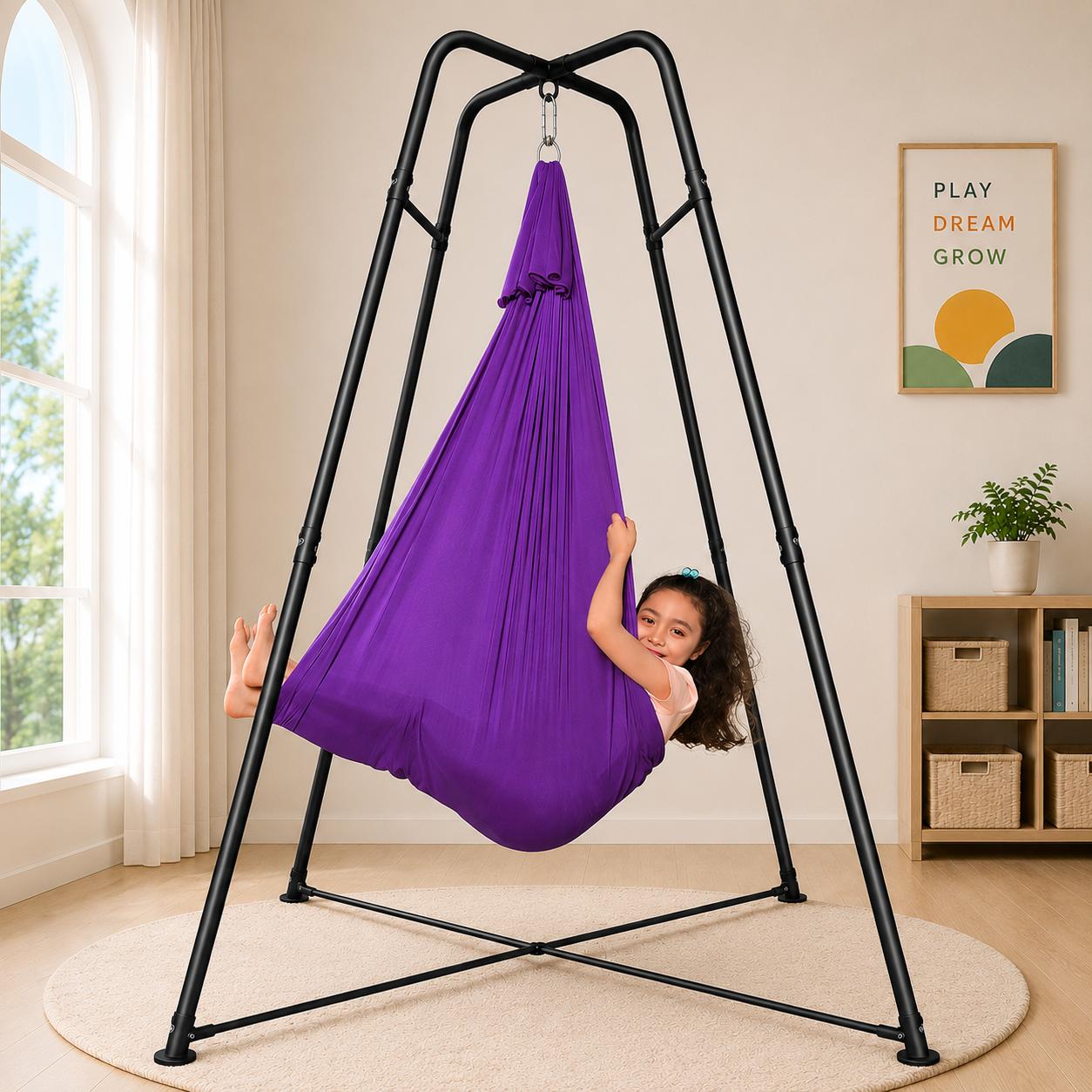
The Vestibular System
The vestibular system helps the body process movement, balance and changes in head position.
Activities that may provide vestibular input include:
- Swinging
- Spinning
- Rocking
- Jumping
- Rolling
- Moving up and down
- Changing direction
Children can respond differently to vestibular activities. Some actively seek movement, while others may feel uncomfortable or overwhelmed by fast or unpredictable motion.
The Proprioceptive System
The proprioceptive system provides information from muscles and joints about body position, effort and movement.
Proprioceptive activities may include:
- Pushing
- Pulling
- Carrying
- Crawling
- Climbing
- Jumping
- Squeezing
- Moving against resistance
These activities help children practise judging how much force to use and understanding where different parts of the body are positioned.
The Tactile System
The tactile system processes information received through touch.
Children encounter tactile input through:
- Textured mats
- Soft-play equipment
- Sensory balls
- Different floor surfaces
- Sand or water play
- Fabric and foam materials
- Barefoot balance activities
Some children enjoy exploring a wide range of textures, while others may prefer gradual and predictable exposure.
What Are Gross Motor Skills?
Gross motor skills involve the larger muscle groups of the body.
Children use these skills for everyday movements such as:
- Sitting upright
- Standing
- Walking
- Running
- Jumping
- Climbing stairs
- Throwing and catching
- Riding a bicycle
- Participating in sport
- Moving around a classroom or playground
Gross motor development involves more than strength alone. It also draws on balance, coordination, timing, posture, endurance, body awareness and motor planning.
For example, stepping across a row of balance stones requires a child to judge distance, shift body weight, stabilise the trunk and place each foot accurately.
How Sensory Integration and Gross Motor Skills Work Together
Movement depends on the brain receiving and using sensory information.
When a child climbs onto a balance board, the brain receives information about the position of the feet, the movement of the board and the direction of the body. The child then adjusts posture and muscle activity to remain balanced.
Similarly, catching a ball requires the child to:
- Watch the ball move.
- Judge its speed and direction.
- Position the body.
- Move the arms at the appropriate time.
- Adjust grip and force.
- Maintain balance while completing the action.
This is why sensory integration and gross motor skill training frequently overlap. Activities that involve movement, resistance, balance and coordination can engage several skills at once.
Why Movement-Based Play Matters
Movement-based activities give children repeated opportunities to explore what their bodies can do.
Depending on the activity and the child’s individual needs, purposeful movement may support practice in areas such as:
- Balance
- Bilateral coordination
- Core stability
- Body awareness
- Hand-eye coordination
- Motor planning
- Postural control
- Strength and endurance
- Spatial awareness
- Confidence during active play
These abilities can contribute to daily activities such as dressing, sitting at a desk, using playground equipment, participating in games and moving safely through different environments.
Movement can also provide a positive break between seated or concentration-heavy activities.
Signs a Child May Benefit from More Movement Practice
Children develop at different rates, and occasional difficulty with a physical activity does not necessarily indicate a developmental concern.
However, parents may notice that a child:
- Avoids climbing or playground equipment
- Frequently trips or loses balance
- Has difficulty catching or throwing a ball
- Appears unsure when moving through obstacle courses
- Finds it difficult to coordinate both sides of the body
- Tires quickly during active play
- Seeks frequent spinning, jumping or crashing activities
- Avoids swings or moving equipment
- Uses too much or too little force
- Finds seated posture difficult to maintain
- Becomes frustrated when learning new physical tasks
These observations can help parents choose appropriate play opportunities. Persistent concerns about movement, coordination, sensory responses or development should be discussed with a qualified health professional.
Sensory Integration and Gross Motor Activities at Home
Effective activities do not always require a large playroom or complicated equipment.
Parents can create short, manageable activities using suitable household items and purpose-designed play products.
1. Indoor Obstacle Courses
An obstacle course can combine several movements in one activity.
A simple course might involve:
- Crawling under a table
- Stepping over cushions
- Walking along a taped line
- Moving across stepping stones
- Throwing a soft ball into a basket
- Jumping to a marked finishing point
Adjust the course to the child’s age, confidence and available space.
2. Balance Activities
Balance activities encourage children to control posture while their body or support surface changes.
Options may include:
- Standing on one foot
- Walking along a line
- Using balance stepping stones
- Rocking on a suitable balance board
- Standing on a wobble cushion
- Moving slowly across different surfaces
Begin with stable, low-level activities before increasing difficulty.
3. Animal Walks
Animal walks provide movement and resistance without requiring specialist equipment.
Examples include:
- Bear walking
- Crab walking
- Frog jumps
- Penguin walking
- Caterpillar crawling
Parents can turn these movements into a race, story or matching game.
4. Throwing and Catching Games
Throwing activities support coordination, timing and force control.
Try:
- Rolling a ball to a partner
- Tossing beanbags into containers
- Throwing at a large target
- Catching a soft balloon
- Passing a ball from side to side
- Playing simple ring-toss games
Start with large, slow-moving objects before progressing to smaller or faster items.
5. Pushing and Pulling Activities
Pushing and pulling can provide muscle and joint feedback while building strength.
Examples include:
- Pushing a filled laundry basket
- Pulling a lightweight wagon
- Moving large cushions
- Carrying books between rooms
- Using resistance bands under supervision
- Playing tug games with suitable equipment
The weight and resistance should remain appropriate for the child.
6. Jumping Activities
Jumping supports coordination, lower-body strength and body awareness.
Children may enjoy:
- Jumping between floor markers
- Hopping over a soft rope
- Following a hopscotch pattern
- Jumping onto coloured shapes
- Using a suitable children’s trampoline with supervision
- Copying simple jump sequences
Keep the landing area clear and use equipment according to the manufacturer’s instructions.
7. Movement-and-Music Games
Music can help children practise timing and movement control.
Ideas include:
- Freeze dancing
- Copying action songs
- Moving quickly and slowly
- Marching to a rhythm
- Stopping when the music pauses
- Copying a parent’s movement sequence
These games can be useful for children who enjoy structure and repetition.
Choosing Suitable Sensory and Gross Motor Equipment
The most expensive or complicated product is not automatically the best choice.
Start by identifying the activity or skill you want to support.
Questions to consider include:
- Does the child enjoy or avoid movement?
- Is the goal balance, coordination, strength or active play?
- Will the product be used at home, school or in a clinic?
- How much space is available?
- Can the child use it safely with appropriate supervision?
- Is it suitable for the child’s age, height and weight?
- Can the activity be adjusted as confidence improves?
- Is the product easy to store and maintain?
- Has a therapist recommended a particular type of activity?
Happy Square organises its products by skill areas such as gross motor skills, sensory stimulation, fine motor development, cognitive skills and play skills, helping families compare resources according to their intended purpose.
Balance Boards and Rocker Boards
Balance boards introduce a controlled unstable surface.
Depending on the design, they may be used for:
- Standing balance
- Weight shifting
- Core engagement
- Kneeling activities
- Seated rocking
- Motor-planning games
Children should begin slowly and use stable support when necessary.
Balance Stepping Stones
Stepping stones can be arranged in different patterns to create pathways and obstacle courses.
They may encourage children to practise:
- Foot placement
- Distance judgement
- Weight transfer
- Balance
- Planning a movement sequence
- Moving between different heights
Stackable products can also be useful where storage space is limited.
Wobble Cushions and Active Sitting Products
A wobble cushion creates a gently moving seated or standing surface.
It may be incorporated into supervised activities involving:
- Posture
- Seated balance
- Short active breaks
- Core engagement
- Foot-placement games
Active sitting products should be introduced gradually rather than used continuously without considering the child’s comfort and needs.
Scooter Boards
Scooter boards can be used for seated, kneeling or prone movement activities, depending on the product and the child’s ability.
They may support practice involving:
- Upper-body strength
- Bilateral coordination
- Motor planning
- Movement through space
- Pushing and pulling
- Team-based games
Use scooter boards on a suitable flat surface away from stairs, traffic, furniture edges and other hazards.
Swivel and Spinning Equipment
Rotating equipment provides vestibular movement input.
Because children respond differently to spinning, use should be closely supervised and introduced in short, controlled periods.
Stop the activity when the child shows discomfort, dizziness, fear, loss of balance or other signs that the experience is not suitable.
Happy Square’s current range includes a sensory-integration swivel chair promoted for families, schools and clinics, alongside other balance and gross-motor products.
Trampolines and Jumping Equipment
Jumping equipment can provide an enjoyable way to practise rhythm, balance and lower-body movement.
When selecting a trampoline, consider:
- Weight capacity
- Available handles
- Product stability
- Floor surface
- Clearance around the equipment
- Age guidance
- Adult supervision
- Storage requirements
Only one child should use the equipment at a time unless the manufacturer specifically states otherwise.
Sensory Training Sets
A combined training set can be useful when parents, teachers or therapists want several activities that address balance, coordination and focus.
Happy Square offers a sensory integration training set designed for home, school and therapy use, with activities targeting balance, hand-foot coordination, body awareness and concentration.
The exact equipment selected should still reflect the child’s individual abilities and the guidance of relevant professionals.
Creating a Simple Home Movement Space
A useful movement space does not need to be large.
A small area may include:
- A soft mat
- Two or three stepping stones
- A balance product
- A basket of balls or beanbags
- Floor markers
- A visual activity card
- A clear storage box
Keep the area uncluttered and separate it from fragile furniture, sharp edges and stairs.
Parents can rotate activities instead of displaying every product at once. This can make the space easier to manage and keep activities feeling fresh.
How Long Should Training Activities Last?
There is no single session length that suits every child.
For many families, short and successful activities are more manageable than long, demanding sessions.
A routine might include:
- Five minutes of jumping or pushing
- A short balance pathway
- Three to five target throws
- A calming finishing activity
- A drink and rest break
Observe how the child responds during and after the activity.
Signs that an activity may need to stop or change include:
- Dizziness
- Nausea
- Sudden tiredness
- Fear or distress
- Loss of coordination
- Headache
- Difficulty settling after movement
- Repeated refusal
The goal is not to force a child to tolerate an activity. It is to provide suitable opportunities for safe, positive participation.
Following the Child’s Interests
Children are more likely to participate when an activity connects with something they enjoy.
A child who likes animals may enjoy animal walks. A child interested in cars may move through a pretend racetrack. A child who enjoys colours may step only on particular coloured markers.
Parents can also offer limited choices:
- “Would you like the balance board or stepping stones?”
- “Should we do five jumps or eight jumps?”
- “Do you want to throw the blue ball or the yellow ball?”
Choices provide structure while giving the child some control over the activity.
Supporting Progress Without Pressure
Progress does not always mean completing a more difficult activity.
Improvement may look like:
- Trying an activity for the first time
- Participating for slightly longer
- Needing less physical assistance
- Recovering balance more quickly
- Following a two-step movement sequence
- Using more controlled force
- Showing greater confidence
- Communicating when an activity feels uncomfortable
Parents can celebrate effort and participation rather than comparing the child with siblings or peers.
When to Seek Professional Guidance
Parents should consider speaking with an appropriate professional when concerns about movement, sensory responses or development are persistent or affect daily life.
Depending on the concern, support may come from:
- A general practitioner
- Paediatrician
- Occupational therapist
- Physiotherapist
- Exercise physiologist
- Speech pathologist
- Child development professional
A professional can assess the child’s needs and recommend activities appropriate to their abilities, goals and health circumstances.
Products and home activities should not be presented as a replacement for individual assessment, diagnosis or therapy.
Using NDIS Funding
Happy Square provides products for NDIS participants and offers a process for customers purchasing through plan-managed funding.
The website asks customers seeking an invoice for a plan manager to provide:
- The plan manager’s email
- The purchaser’s email
- The participant’s name
- The participant’s date of birth
- The NDIS number
- The delivery address
- A contact phone number
- A list or screenshot of the required products
Happy Square then sends an invoice to the customer and plan manager. Products are dispatched after payment approval.
Eligibility depends on the participant’s plan, goals, funding arrangements and plan-manager requirements. Customers should confirm whether a product can be claimed before ordering.
Shopping for Schools and Clinics
Happy Square also supports schools, clinics and organisations through purchase orders and trade-account applications.
Its website lists products for:
- Classroom movement breaks
- Therapy sessions
- Gross motor programs
- Sensory rooms
- Physical education activities
- Early-intervention environments
- Home-based developmental play
Schools and organisations can use Happy Square’s purchase-order process, which offers invoicing with payment terms for eligible orders.
Safety Considerations for Parents
Movement equipment should always be used according to the product instructions.
Before each activity:
- Check the product for damage or loose parts
- Confirm age and weight suitability
- Clear the surrounding area
- Use the product on an appropriate surface
- Provide suitable adult supervision
- Introduce unfamiliar movement gradually
- Keep activities away from stairs and hard edges
- Stop if the child appears distressed or unwell
- Follow professional advice where applicable
Sensory preferences can change depending on tiredness, illness, noise levels and the environment. An activity that feels enjoyable one day may feel overwhelming on another day.
Frequently Asked Questions
Are sensory integration and gross motor skills the same?
No. Sensory integration relates to how the nervous system processes and responds to sensory information. Gross motor skills involve large-body movements such as balancing, jumping and climbing. They are different areas, but they often work together during movement.
What age should gross motor skill training begin?
Movement development begins from infancy. Activities should always be adapted to the child’s age, stage, health and individual abilities.
Can sensory equipment be used at home?
Many sensory and gross-motor products are designed for home use, but parents should check space, supervision, age guidance, weight limits and safety instructions before purchasing.
Does every child need sensory toys?
No. Sensory products are tools rather than universal requirements. The right choice depends on the child’s interests, needs, environment and any recommendations from professionals.
How do I know which product to choose?
Start with the activity you want to support, such as balance, jumping, coordination or active sitting. Review the product specifications and consult an occupational therapist or other qualified professional when individual guidance is needed.
Can Happy Square supply schools and clinics?
Yes. Happy Square offers products for schools, clinics and organisations, along with purchase-order and trade-account options.
Can I use NDIS funding to purchase sensory products?
Some customers may be able to purchase suitable products through their NDIS funding arrangements. Approval depends on the participant’s plan and funding management, so eligibility should be confirmed with the plan manager or relevant NDIS professional.
Final Thought
Sensory and gross-motor development does not have to feel like formal training.
For many children, the most valuable opportunities come through simple and enjoyable play: balancing across stepping stones, jumping to a coloured marker, pushing a basket, catching a soft ball or moving through an obstacle course.
The purpose of sensory integration and gross motor skill training is not to make every child respond or move in the same way. It is to provide appropriate opportunities for children to explore movement, understand their bodies and gradually build confidence.
By selecting activities that suit the child’s interests, abilities and environment, parents can make active play a positive and sustainable part of everyday life.
Address and Contact Details
Happy Square AU
Unit 6, 4 Vesper Drive
Narre Warren VIC 3805
Australia
Phone: 0430 750 122
Email: happysquareau@outlook.com
Ordering and Enquiry Details
Happy Square operates primarily as an online sensory and educational product store rather than an appointment-based therapy provider.
To place a standard order:
- Visit the Happy Square website.
- Browse by product collection or developmental skill.
- Review the product description, age guidance and available options.
- Select the required style, size or colour.
- Add the product to the shopping cart.
- Enter delivery and payment details at checkout.
- Submit the order and retain the confirmation email.
Orders are generally processed within one to three business days. Delivery charges and expected timeframes are calculated according to the available Australia Post or Sendle service. Free shipping is currently advertised for eligible orders over $99.
NDIS Plan-Managed Orders
For an NDIS plan-managed purchase:
- Add the required products to the shopping cart.
- Take a screenshot or prepare a product list.
- Email the list to happysquareau@outlook.com.
- Include the participant and plan-manager information requested by Happy Square.
- Wait for the invoice to be issued to the customer and plan manager.
- Happy Square will dispatch the products after payment approval.
School, Clinic and Organisation Orders
Schools, clinics and eligible organisations can complete the purchase-order or trade-account form on the Happy Square website.
For product guidance, bulk purchases or order questions, contact the team on 0430 750 122 or email happysquareau@outlook.com.